When Disaster Strikes: What Do We Save First?
There is a particular kind of phone call that people who care for collections hope never to receive.
There has been a flood.
A pipe has burst.
A storm has damaged the building.
There is water in the collection store.
Something has happened, the normal systems have stopped working, and suddenly decisions about collections that might ordinarily take weeks or months need to be made in minutes.
For museums, galleries, archives, marae, whare taonga and other organisations caring for cultural heritage, disaster planning is becoming an increasingly important part of collection care. Severe weather, flooding, earthquakes, fire, building failures, water ingress and the mould that often follows can all put collections at risk.
But my understanding of disaster response has not come only from plans, guidelines or conservation training.
It has come from standing in the middle of real disasters and discovering that the hardest question is often not how to save something.
It is what do we save first and who gets to decide?
A lesson from Haiti that changed my practice
Following the devastating Haiti earthquake of January 2010, I had the opportunity as a young conservation professional to assist with the Smithsonian-led cultural recovery effort. For those interested, there are some great articles and photos form the experience by the Smithsonian Institute and an excellent presentation by then Under Secretary Richard Kurin.
There were damaged collections everywhere, and I fell naturally into the way I had been trained to think. Look at the materials. Assess their condition. Identify what is deteriorating most quickly. Establish priorities. Get started.
I remember looking at some of the fragile paper material and saying something along the lines of:
"Right, let's get these paper items looked at first. They're the most vulnerable."
The Haitian professionals we were working alongside stopped me.
No.
They wanted to work on the fer découpé sculptures first.
Fer découpé, intricately cut and worked metal sculpture, is a distinctive Haitian artistic tradition.
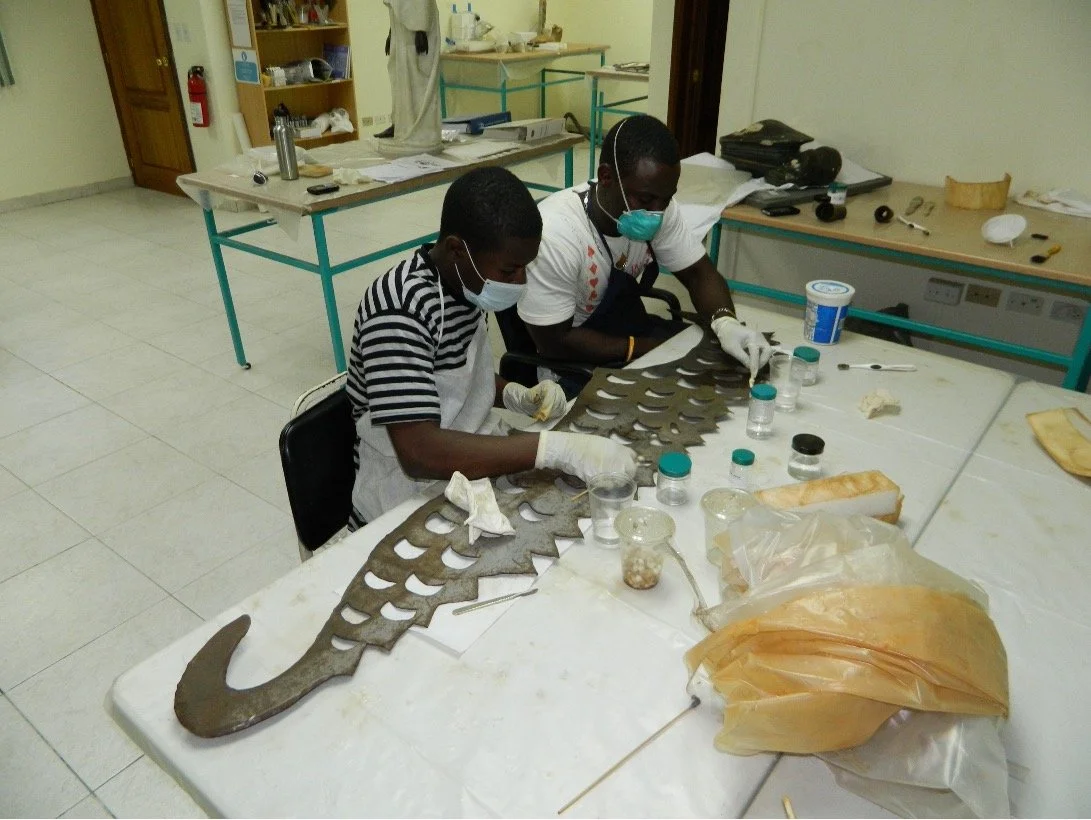
Two of the amazing Haitian and Dominican Republic artists that I worked with cleaning a fer découpé sculpture.
To me, looking at the collection through the eyes of a conservator, the paper appeared to present the more urgent material problem.
But my Haitian colleagues were assessing something I hadn't considered.
They explained that the sculptures represented their people and their identity.
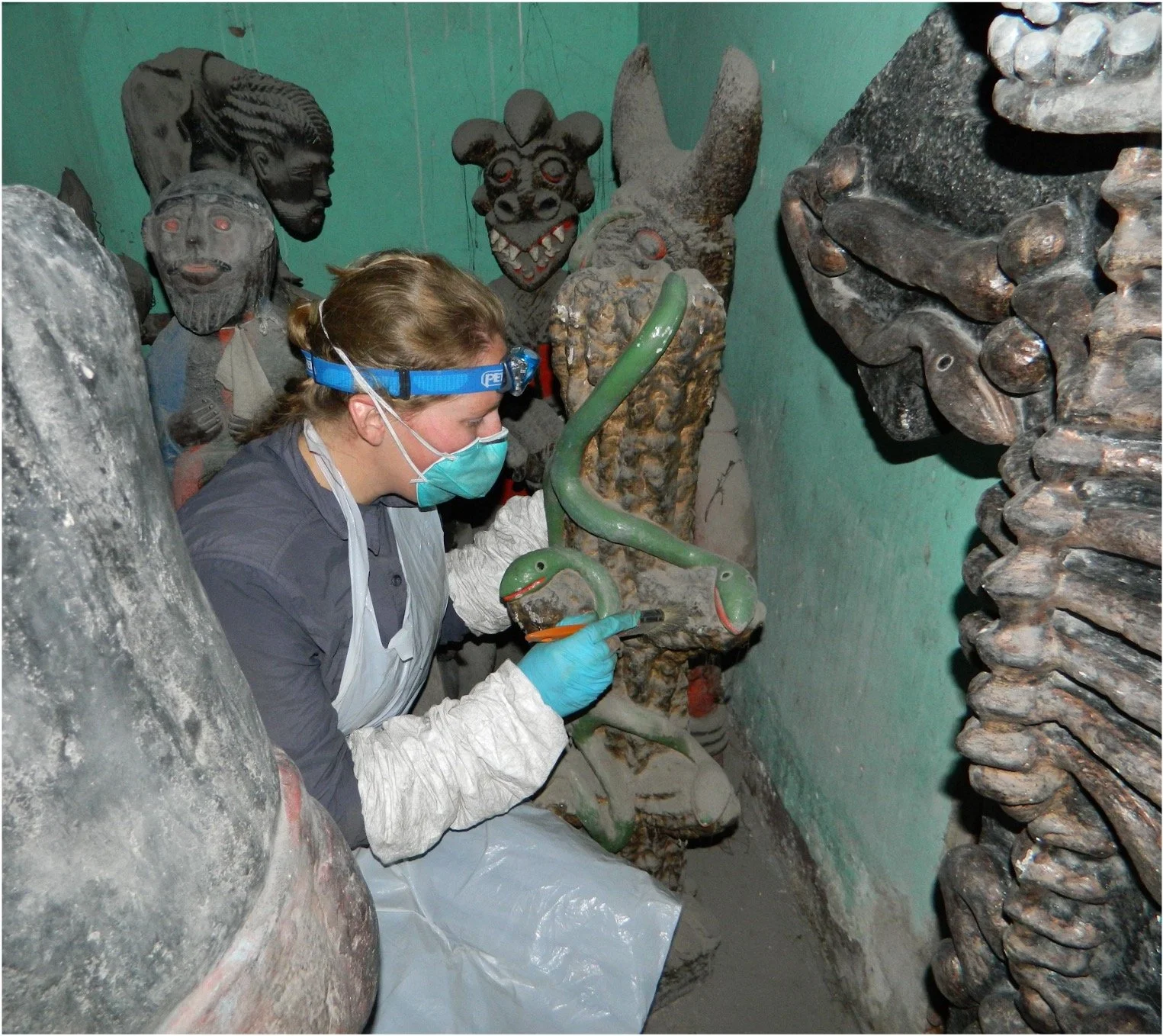
The author cleaning an intricate concrete gravesite marker of concrete dust.
After an earthquake that had caused incomprehensible loss (entire families taken away), these objects represented something about survival, continuity and rebuilding.
That conversation was transformational for me.
I wasn't necessarily wrong about the paper being physically vulnerable.
I was wrong in assuming that physical vulnerability was the only thing that should determine our priority.
There is a significant difference between asking:
"Which object is deteriorating fastest?"
and asking:
"What matters most to the people recovering from this disaster?"
Good disaster response has to make room for both questions.
Sometimes disaster recovery involves a very large ham
Not every disaster response story is quite so profound.
Some are memorable for entirely different reasons.
Earlier in my career I also assisted following a major flood at a small museum in Virginia. Collections needed to be assessed and relocated as part of the recovery effort.
Among them was a rather unusual local treasure: a famous preserved Smithfield ham.
Yes, an actual ham.
The Isle of Wight County Museum in Smithfield is home to P.D. Gwaltney Jr.'s celebrated preserved ham, which dates from 1902. The museum itself suffered a serious flood following a nor'easter in 2006.
So, among the many things I can say I have helped move during my conservation career, an exceptionally old preserved leg of ham is one of them.
It makes for a good story now.
At the time, however, it illustrated something quite important about emergency response.
You rarely get the collection you practised on in a training exercise.
A disaster doesn't neatly affect one shelf of archival boxes containing identical materials. It can involve paper, furniture, paintings, archaeological material, photographs, textiles, natural history specimens, oversized objects and, apparently, historic cured meat.
All at once.
You have to work out what has happened, whether the space is safe, what can remain where it is, what needs to move, what is wet, what can wait, what needs immediate attention, where things will go, who is recording those movements, and whether you actually have the people and equipment required to do any of it.
That is why preparedness matters.
Disaster response starts before the disaster
Emergency collection work can look dramatic in photographs: conservators in PPE, wet objects laid out to dry, crates being moved and salvage areas being established.
But some of the most important disaster work happens long before any of that.
It happens when a team sits together and asks:
Who is responsible for making decisions?
Who has authority to enter collection areas?
What are our collection and taonga priorities?
Who needs to be consulted?
Where are our emergency supplies?
How will we document objects if they have to be moved quickly?
Where could we establish a temporary salvage area?
What happens if the person who wrote the emergency plan isn't there?
Does everyone actually understand the plan?
And have we ever practised using it?
This last question matters.
A beautifully written emergency plan is useful only if people can turn it into action when they are tired, stressed, working with incomplete information and facing several problems at once.
Our new Disaster Planning, Emergency Response & Recovery training has been developed around exactly that reality.
It draws on our team's practical experience with earthquakes, flooding, water damage, mould, building failures and large-scale collection recovery, including the Smithsonian-led Haiti cultural recovery project and more recent recovery work involving thousands of water-damaged documents.
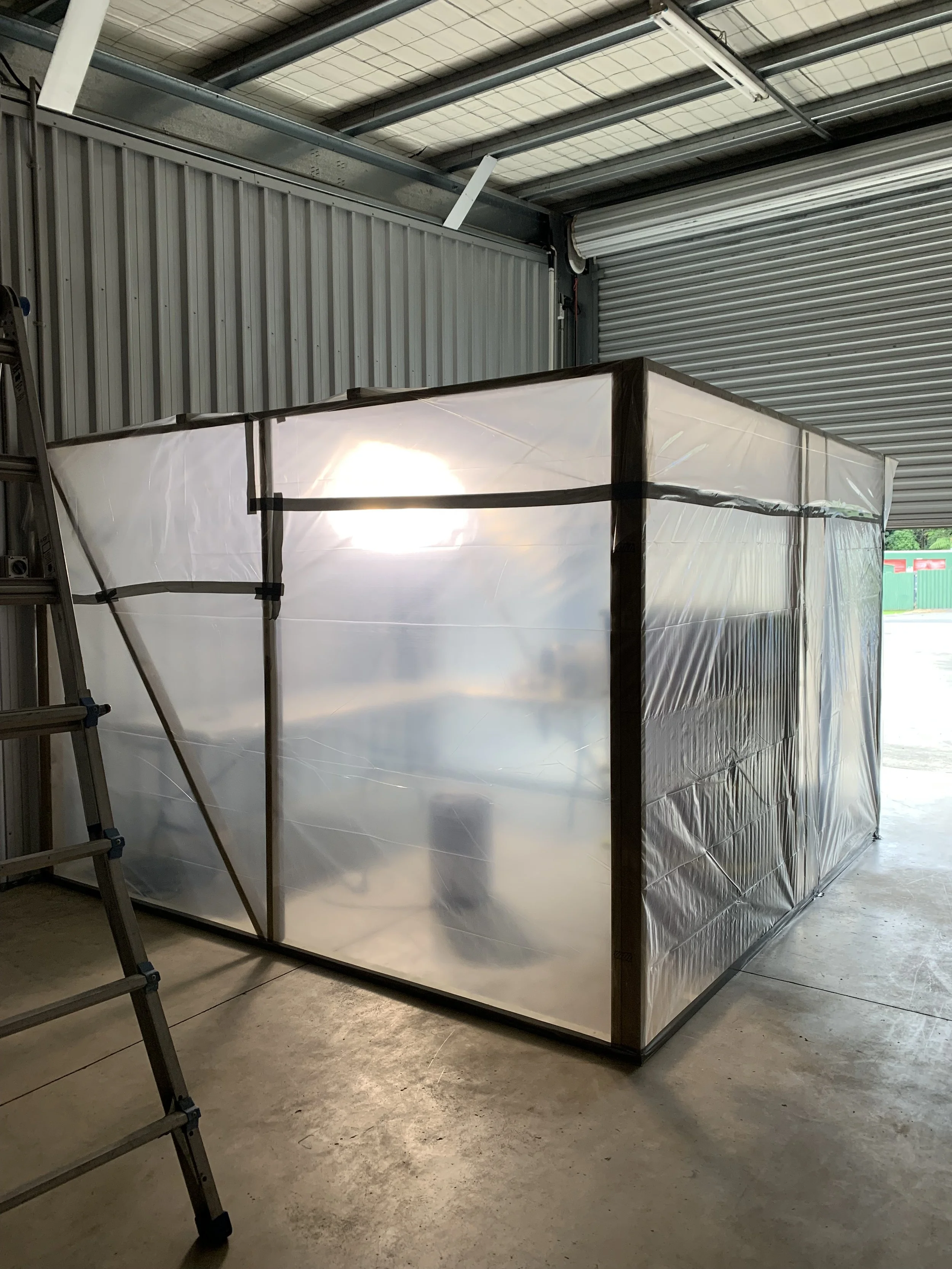
Mould contaminated materials triage area.
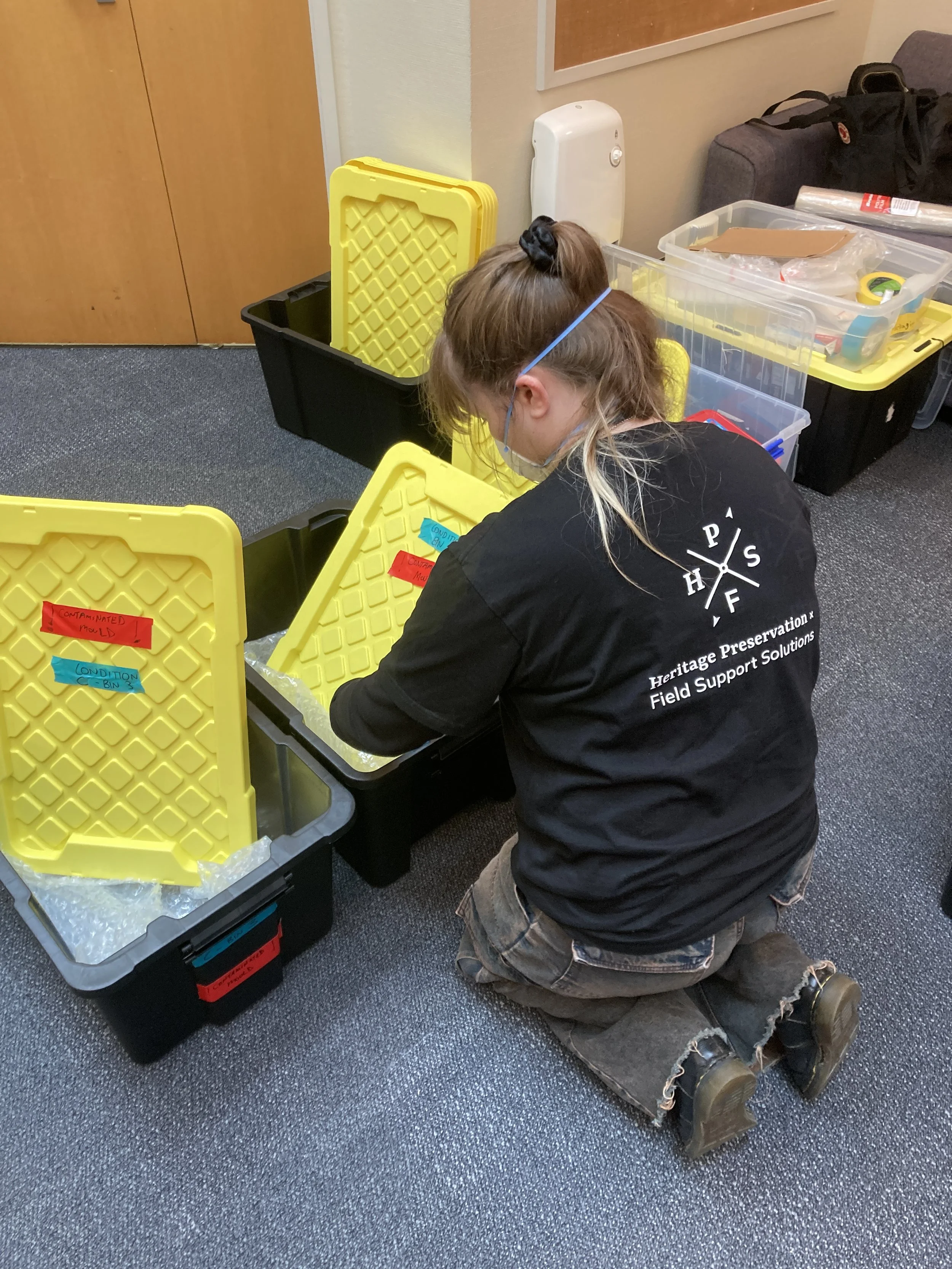
Our Conservation Assistant, Renee, preparing packaging materials to transport contaminated items.
Building confidence before something goes wrong
We have developed three areas of disaster training that can be delivered independently or adapted to the needs of an organisation.
Disaster Planning & Preparedness focuses on what happens before an incident: understanding your risks, clarifying responsibilities, establishing collection and taonga priorities and developing an emergency plan that people can actually use.
Emergency Response & Decision-Making looks at those crucial first stages after something has happened. Before conservation treatment begins, people need to assess the situation safely, establish roles, document damage, set priorities and coordinate a response.
Collections Salvage & Recovery gets practical. Participants can practise establishing a salvage operation, triaging mixed collections, handling wet and fragile material, documenting movement, using basic drying and packing approaches, and recognising when specialist assistance is needed.
The workshops do not necessarily need to be completed in sequence, and organisations do not need to already have an emergency response plan. Training can be adapted around the collections, risks, experience and systems an organisation already has in place. For marae and whare taonga, that can also include tikanga, access requirements and local decision-making structures.
Because no two collections, and no two disasters, are identical.
The lesson I still carry from Haiti
More than fifteen years later, I still tell the story about those fer découpé sculptures.
It reminds me of something I now believe very strongly about conservation.
Technical expertise matters.
Training matters.
Planning matters.
Knowing how different materials respond to water, heat, mould and physical damage absolutely matters.
But expertise does not give us sole ownership of the decisions.
The people connected to collections bring knowledge that a conservator cannot acquire simply by looking at an object's materials. They understand cultural importance, whakapapa, identity, memory and meaning.
In Haiti, I arrived ready to identify which objects needed us most.
Instead, I learned to ask the people around me what they needed from us.
That lesson has shaped much of my practice since.
It is also why our approach to disaster training isn't simply about teaching people how to rescue damaged objects. It is about helping teams build the confidence, relationships and decision-making structures they will need when the unexpected happens.
Because when water is already coming through the ceiling, it is too late to have some of these conversations for the first time.
And whether the object in front of you is a fragile document, a culturally significant sculpture, a taonga — or even an enormous preserved ham — knowing what to do next can make all the difference.
Explore our new Disaster Planning, Emergency Response & Recovery training and find the workshop or support that is right for your organisation: https://heritagepreservation.co.nz/disaster-training