

Why Do We Have a Climate Room? Measuring Before We Manage
I was recently chatting with Renee, our Conservation Assistant and Registrar, about our climate room and a deceptively simple question came up: what do we actually want this room to do?
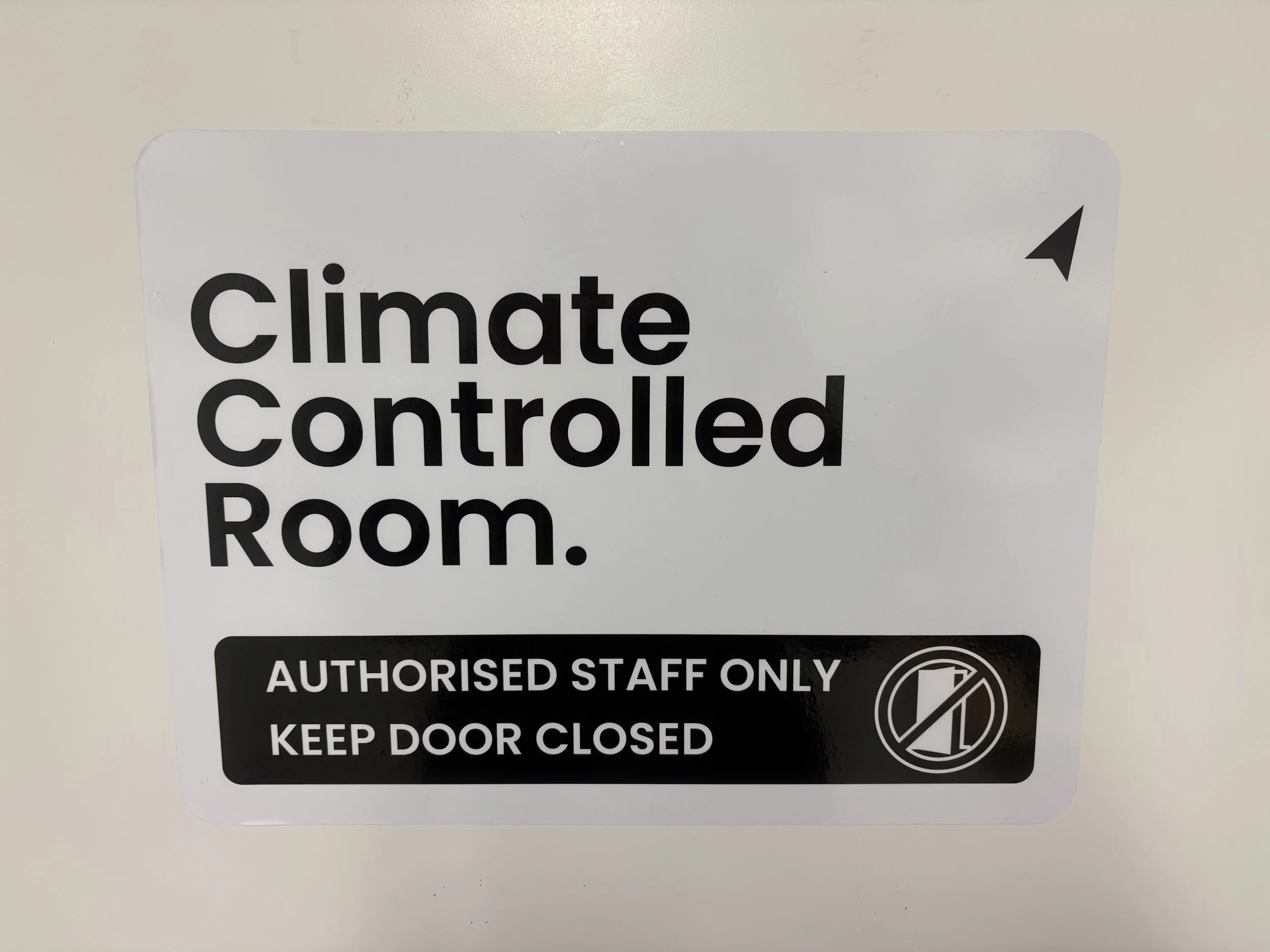
It is easy to think that a climate-controlled room should simply meet a particular “museum standard”. Set the temperature, set the relative humidity, and job done.
But environmental management in conservation is much more critical than hitting a number.
For us, the purpose of monitoring our climate room is to understand how the space actually behaves, how well the building protects what is inside it, and what the collections using the room really need. That information then helps us make better decisions about preservation, loans, building maintenance and where it is worthwhile investing our resources.
First, we need to know what the room is doing
Temperature and relative humidity can influence the long-term stability of cultural materials. Organic materials such as wood, paper, textiles and some painted surfaces can respond to changes in moisture in the air. Metals may have very different requirements, particularly where corrosion is active. Photographic and modern materials introduce still more variables.
So simply taking one reading tells us very little.
Continuous monitoring allows us to see patterns.
What happens overnight? What happens after several days of rain? Does the room respond immediately when exterior conditions change, or does the building provide some buffering? Are there seasonal patterns? Does opening a door have a noticeable effect? Does one part of the room behave differently from another?
That last question about buffering is particularly useful. Buildings are themselves part of an environmental control system. Walls, insulation, air movement, the position of a room within a building and the way a space is used can all influence how quickly exterior conditions make their way indoors.
Rather than assuming our room is well buffered, or poorly buffered, we can measure it.
The data can tell us about the building too
Environmental monitoring is not only about collections.
A sudden change in the data might be the first clue that something else has happened: a leak, unexpected moisture entering the building, increased air exchange, a door being left open, or a change in how a room or piece of equipment is operating.
Over time, monitoring gives us a picture of what is normal for the space. That makes the abnormal much easier to spot.
This turns a temperature and relative humidity logger into something more useful than a compliance tool. It becomes part of understanding the building itself.
And ultimately, the room has to work for people
Museums and conservation studios are not sealed boxes. They are places where people work with, study, care for and access collections.
This has been part of the conversation about museum environments for a surprisingly long time. In his influential 1956 book The Conservation of Antiquities and Works of Art, British Museum conservator Harold Plenderleith discussed what he called the “museum climate”. Temperature in gallery spaces was partly a question of human comfort, while environmental conditions also needed to support the preservation of collections.
That balance still matters.
There is little benefit in designing an environmental system in isolation from the people who need to use the room, particularly in a working conservation studio. Good environmental management should support both collection care and the practical use of a space.
So, what is the “museum standard”?
This is where things get complicated.
For much of the twentieth century, conservation guidance increasingly centred on relatively narrow temperature and relative humidity targets. Plenderleith's work was highly influential in this history. His observations of museum collections stored under controlled conditions during the Second World War helped establish the idea that stable temperature and humidity could significantly improve preservation.
Those early numbers were important steps in preventive conservation, but they were never the end of the story.
Today, environmental guidance is increasingly based on the material, condition and history of a collection, the building in which it is housed and the local climate. The joint environmental declaration of the International Institute for Conservation and ICOM's Committee for Conservation specifically states that environmental conditions for permanent collections should be achievable within the local climate. It also encourages passive approaches, simple technologies and lower-energy solutions rather than assuming that air conditioning is always the answer.
That is particularly relevant in Aotearoa.
Even within New Zealand guidance, different materials have different needs. Te Papa's public collection-care guidance, for example, gives different recommended environmental ranges for textiles and kākahu than for photographic collections.
So a single number described as “museum standard” can hide a lot of complexity.
It can also come at a cost. Attempting to maintain very narrow conditions throughout every season may require considerable mechanical heating, cooling or dehumidification. International conservation guidance now explicitly asks museums to consider energy use, carbon footprint and sustainable alternatives when developing environmental strategies.
Loan requirements add another layer
Environmental records can also become important when an organisation wants to borrow an artwork or object.
A lender may ask for information about the conditions in which their object will be displayed or stored. Being able to provide genuine monitoring data is much more meaningful than simply saying that a room is “climate controlled”.
Interestingly, current international guidance also asks lenders to be realistic. The IIC and ICOM-CC declaration notes that conditions developed for international loans should not automatically become the requirements for every permanent collection. It encourages transparency about the conditions an institution can actually achieve and recognises that, where an individual object requires something different, a microclimate may be an appropriate solution.
Our approach: build from the data
At Heritage Preservation, we are interested in starting with evidence rather than starting with equipment.
Before deciding that a room needs another dehumidifier, a heat pump or a larger environmental control system, we want to understand the problem we are trying to solve.
If the data shows that relative humidity rises only under particular exterior conditions, the solution may be targeted. If it shows that the room closely follows every change outdoors, we might investigate the building fabric or air entry first. If there are occasional localised problems, improving storage or creating a microclimate may be more effective than trying to condition an entire room.
That means we can use our resources where they will make the greatest difference.
It is both a conservation decision and a sustainability decision.
One room, many materials
Our climate room also needs to accommodate a mixed collection.
That makes the idea of one perfect environment particularly difficult. A condition that suits one material exceptionally well may not be ideal for another.
Our aim, therefore, is to use monitoring to establish a sensible, stable general environment for the room and then identify objects that need something more specialised. Where necessary, those objects can be given their own microclimate through appropriate enclosures, cabinets, crates or other targeted environmental controls.
In other words, we do not necessarily need to make the whole room behave like the most sensitive object in it.
The goal isn't a perfect number
The more useful question for us is not:
“Are we meeting museum standards?”
It is:
“Do we understand this environment well enough to know whether it is appropriate for the collections and people using it?”
That means knowing what the room normally does. It means understanding how the exterior climate and the building interact. It means being able to recognise emerging problems. It means having the evidence needed for loan discussions. And it means making deliberate decisions about when additional equipment or more specialised environmental control is genuinely justified.
The little data logger quietly recording conditions in the corner of the room is therefore doing quite a lot of work.
It is helping us move from assumptions to evidence and from simply controlling an environment to understanding it.